Use of Standard Components in Press Tools
In modern manufacturing, time, precision and reliability are critical to the performance of press tools. The use of standard components is an effective way to achieve all three while reducing overall tooling costs and lead time.
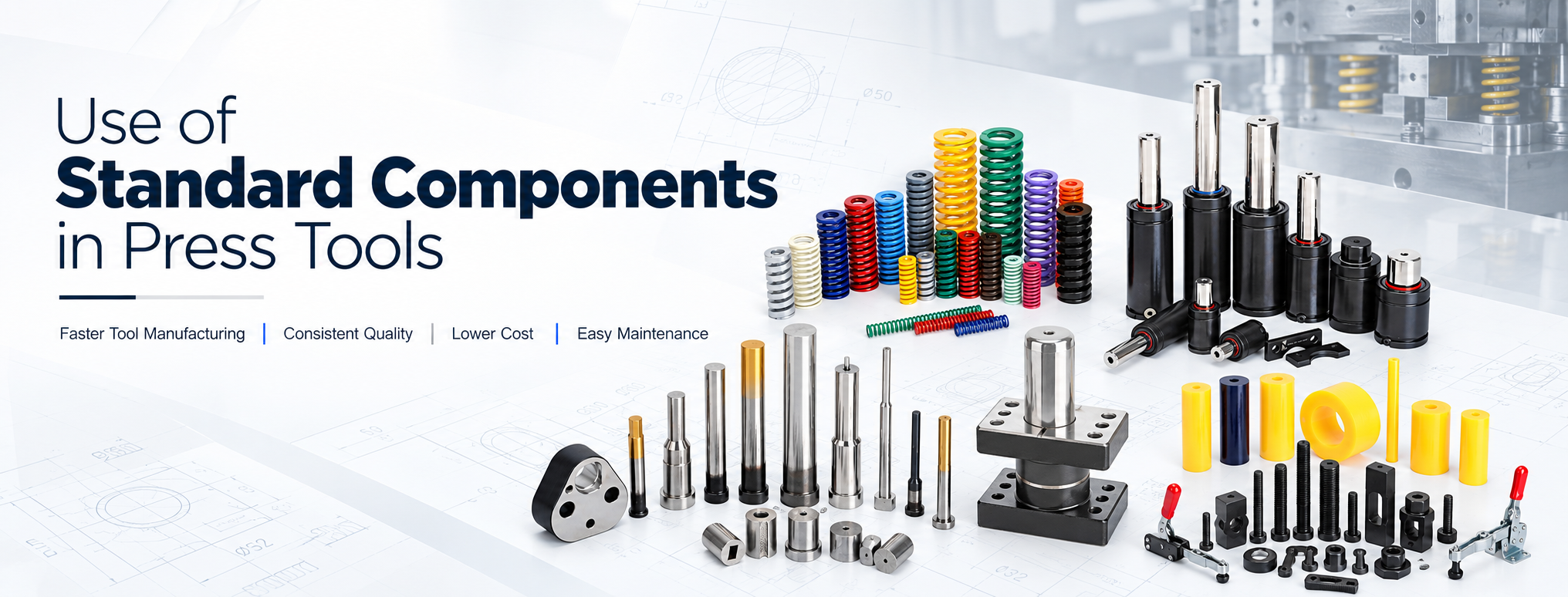
Standard components such as guide pillars, guide bushes, punches, die buttons, springs, retainers, dowels and standard die sets are manufactured to established dimensions and specifications. These components can be readily integrated into press tools, reducing the need to manufacture every part from scratch.
Key Benefits
1. Reduced Manufacturing Time
Using ready-to-use components reduces machining, grinding, heat treatment and inspection requirements. This helps shorten the overall tool manufacturing cycle.
2. Consistent Quality
Standard components are manufactured under controlled processes, providing consistent dimensions, material properties and surface finish. This is particularly important for accurate tool alignment and repeatable production.
3. Lower Overall Cost
The true cost of a component includes machining, labour, processing and inspection. Standard components can reduce these activities and therefore lower the overall lifecycle cost of the tool.
4. Easy Maintenance
Standard components are easier to identify and replace. If a component such as a spring, guide bush or die button requires replacement, the specified part can be procured without redesigning the tool.
5. Better Standardization
Using common components across multiple tools simplifies design, procurement and inventory management. It also improves interchangeability and reduces dependency on specially manufactured parts.
Standardization + Engineering
A modern press tool does not have to be completely standardized. The most effective approach is to combine standard components with application-specific engineering.
Components such as guide systems, springs and fasteners can be standardized, while special punches, forming inserts, die profiles and other critical components can be designed specifically for the application.
This allows engineers to focus their efforts on the areas where customization adds real value.
Choosing the Right Component
Standardization should never compromise performance. Components must be selected based on factors such as load, stroke, operating speed, material, accuracy requirements, tool life and working conditions.
The right combination of standard components and customized elements can result in press tools that are faster to manufacture, easier to maintain and more reliable in production.
At Practic Industries, we believe that efficient tooling is about more than individual components—it is about creating reliable and practical manufacturing solutions. Standardization is an important part of this approach, helping manufacturers improve productivity while maintaining the quality and precision demanded by modern industry.