Die Springs vs. Gas Springs in Press Tools
In press tool design, the spring system plays an important role in return force, stripping, lifting and controlled movement. Two commonly used solutions are die springs and gas springs. Choosing between them depends on the required force, available space, stroke, operating conditions and application.
Die Springs
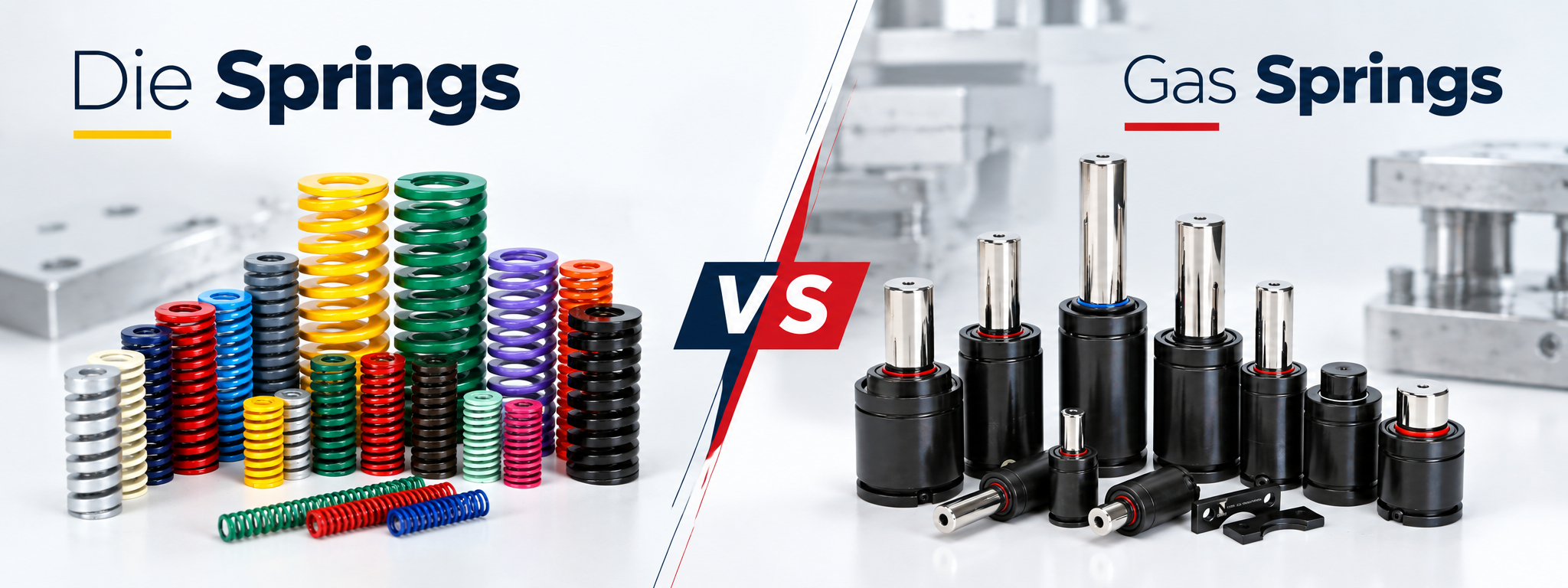
Die springs are mechanical compression springs specifically designed for use in dies, moulds and tooling applications. They are available in different sizes and load capacities and are commonly colour-coded according to their load characteristics.
Advantages of Die Springs
Simple and reliable construction
Easy to install and replace
Available in a wide range of sizes and loads
No gas charging system required
Suitable for many conventional press-tool applications
Generally economical for standard applications
Die springs are particularly suitable where the required force can be achieved within the available installation space and stroke.
Gas Springs
Gas springs use compressed nitrogen to generate force. Unlike conventional coil springs, gas springs can provide high force from a relatively compact package.
They are commonly used for applications such as:
Heavy-duty stripping
Large press tools
Forming operations
Automotive tooling
Applications requiring controlled and consistent force
Advantages of Gas Springs
High force in a compact size
More consistent force through the working stroke
Available in different force capacities
Suitable for high-load applications
Can reduce the number of individual springs required in some tool designs
Die Springs vs Gas Springs
|
Parameter |
Die Springs |
Gas Springs |
|
Working principle |
Mechanical compression |
Compressed nitrogen |
|
Force capacity |
Low to high |
High |
|
Space requirement |
Can require more space
at high loads |
Compact for high
forces |
|
Force characteristics |
Increases
with compression |
Relatively
consistent |
|
Maintenance |
Simple replacement |
Requires appropriate
inspection/service |
|
Installation |
Simple |
Requires
correct mounting |
|
Initial cost |
Generally lower |
Generally higher |
|
Typical applications |
General press
tooling |
High-load
& demanding tooling |
Which One Should You Choose?
There is no single solution for every press tool.
Die springs can be a practical choice for conventional applications where simplicity, availability and cost are important.
Gas springs can be advantageous when the tool requires high force, limited installation space or more consistent force throughout the stroke.
The selection should consider the required force, working stroke, installation space, cycle frequency, operating temperature, safety requirements and expected service life.
Final Thought
The right spring is not simply the one that fits the tool—it is the one that provides the required force and performance throughout the tool's operating cycle.
At Practic Industries, we supply standard tooling components that help manufacturers select practical and reliable solutions for their press-tool applications.